
Below is my personal take on Killer—how I first stumbled onto it, the wild moments I’ve experienced, plus my own tips and handicap options for mixing skill levels. I first played it on a family holiday to Turkey, where 16 players of mixed abilities got involved.
How Killer Works
- Number of Players
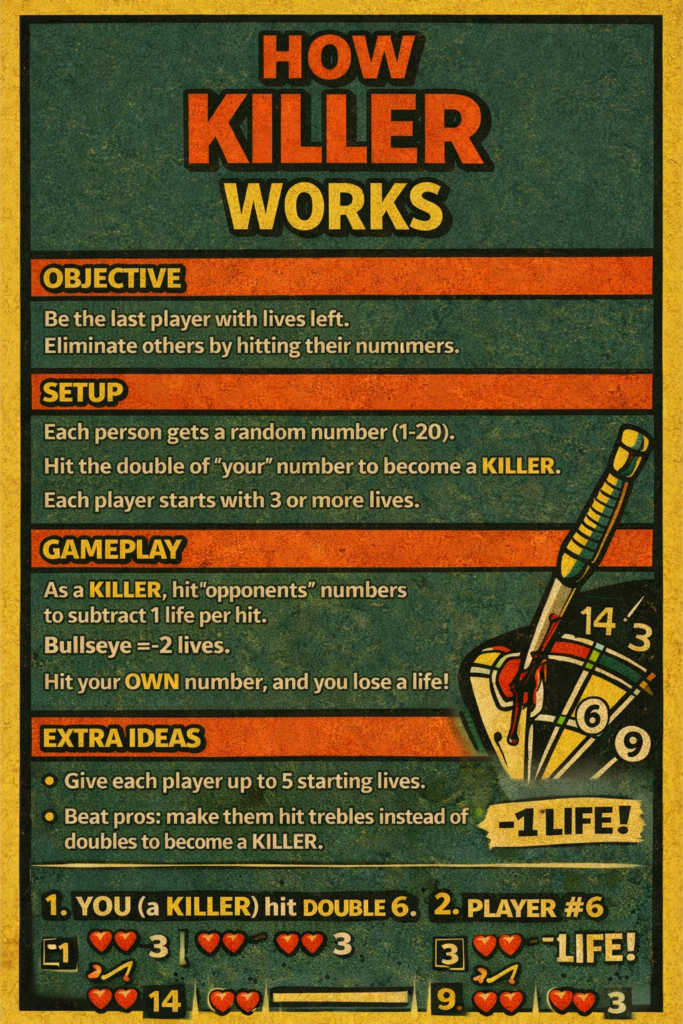
- Killer works best with 3 or more players—ideally 4 to 6 for the perfect mix of chaos and manageability. But I’ve played with as many as 16 people, and while it’s a bit longer, it’s still a blast.
- Choosing Your Number
- Each player randomly gets a number from 1 to 20. Often, we do this by throwing a dart left-handed (or with your non-dominant hand) at the board. Whichever segment you hit is your “number.” If you miss or land on a previously claimed number, throw again until you land a unique one.
- Lives
- Each person starts with a set number of lives—commonly 3, but you can do 5 if you’ve got fewer people.
- We usually mark everyone’s lives on a chalkboard or a piece of paper so it’s easy to see who’s in trouble. (Or some score apps now have the game on, I just find paper is easier for this one, where no maths is involved!)
- Becoming a Killer
- At the start, everyone’s “safe” until they’ve hit the double of their own number once. For lower players, you can play justby hitting your number to become the killer
- The moment you hit your double, you become a “Killer.” Now you can eliminate opponents’ lives by hitting their numbers.
- Eliminating Opponents
- Each time you hit someone else’s number (while you’re a Killer), you remove one of their lives. If they had 5, now they have 4, and so on.
- Once a player’s lives hit 0, they’re out of the game.
- Winning
- The game continues until only one player remains with at least one life.
- That player is crowned the “Ultimate Killer.”
Tips & Tricks
- Secure Your Double Early
- Becoming a Killer ASAP can give you a head start on eliminating others. Take your time lining up that shot for your own double—sometimes that’s more crucial than attacking someone else.
- Play Mind Games
- If someone’s got a bullseye as their number or a notoriously tricky double, they might take longer to arm themselves. Meanwhile, if you see someone with an easy double (like Double 16 for an experienced player), keep an eye on them—once they become a Killer, they can do damage fast.
- Target Wisely
- Going after the strongest player first is often a good strategy, but sometimes you want to take out the easier targets to reduce the total number of Killers. Weigh your options based on the dynamics of your group.
- Practice Your Doubles
- This game highlights how crucial doubles can be. Even if you’re decent at hitting big scoring numbers, getting comfortable with doubles all around the board is key.
- Don’t Forget Defense
- A subtle but effective defensive move is to consistently threaten the biggest threat in the group. If they feel the heat, they might divert their attention to a different target, giving you a chance to survive longer.
Handicap Options
Since Killer can be brutal on newcomers, here are a few ways to even the playing field:
- Extra Lives for Beginners
- Give newcomers an additional life or two (say 6 or 7) while more skilled players start with 5. It cushions them against early knockouts.
- Restricted Targets for Veterans
- Force advanced players to only count a successful hit if it’s on the double and the outer bull of an opponent’s number (i.e., a smaller segment). Meanwhile, beginners can aim at any double of the number to kill a life.
- Delayed Killing
- Make highly skilled players wait until they’ve hit their double twice before they can start killing others. Beginners only need the standard single double hit.
- Team Variation
- Pair a newbie with an experienced player. Each team shares lives, and they take turns throwing. It fosters cooperation and coaching.
- Range of Numbers
- If a newcomer gets a tough double (like Double 19 or Double 17), allow them to choose a different number from an easier range (e.g., 1–10). This keeps frustration levels down.
Why I Love Killer
Killer is all about tension and alliances that can shift in a heartbeat. One minute, everyone’s after the front-runner; the next minute, someone sneaky emerges from the back to knock out half the group. It’s also a fantastic introduction to the importance of doubles in darts—there’s no better motivator than survival to make you focus on your aim!
Beyond the skill aspect, the social side of Killer is unmatched. Whether you’re shouting in victory as you eliminate a friend’s last life or groaning as you see your own counter go to zero, you can’t help but have a good time. It’s a wonderful mix of laid-back fun and fierce competition.
So, if you’re looking for a game that ups the drama and keeps everyone engaged until the final throw, Killer is a must-try. Just prepare for some friendly grudges—after all, it’s called “Killer” for a reason! Enjoy, and may the doubles be ever in your favour.