
Below is my personal take on Round Robin Knockout—how I first got into it, why it’s a fun change of pace from traditional “round-based” darts, plus some tips and handicap ideas I’ve picked up along the way.
I first came across Round Robin Knockout in a small pub tournament. Instead of the usual “best of 3 legs in 501,” the organiser ran a mini bracket for each pair of players, ensuring everyone got multiple short matches. It felt like we were all in our own mini-championship—lots of quick head-to-head matches, then winners moving on. The atmosphere was electric because everyone was constantly engaged, either playing or cheering for the next showdown.
How Round Robin Knockout Works
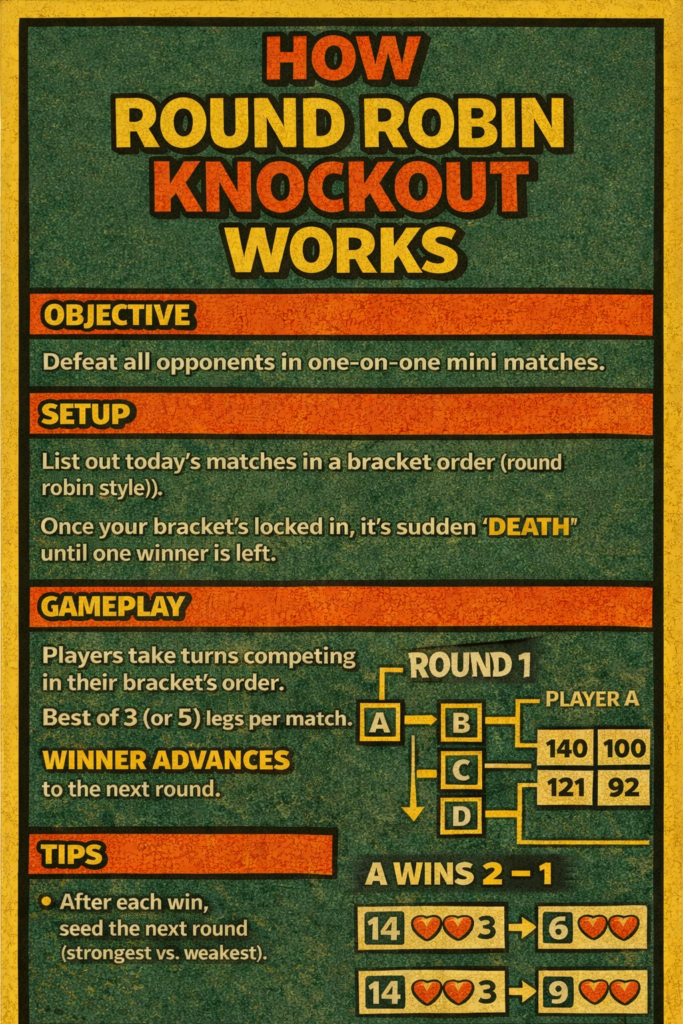
While there are variations, here’s the basic idea:
- Setup
- Each participant (or team) is entered into a round-robin schedule, meaning everyone faces everyone else at least once in a short match.
- Alternatively, you can have small “groups” or “pools” if you have many players—everyone in a group plays each other, then top players advance to a knockout bracket.
- Match Format
- Each match is typically a shortened version of a standard darts game—like 1 or 2 legs of 301 or 501, or even a single leg if you want it really quick.
- The winner of each match gets a “win” on the record (and possibly some points in a table).
- Advancing / Knockout Stage
- After the round-robin portion, you rank participants based on matches won (and sometimes points difference if there’s a tie).
- The top contenders move on to a knockout bracket (quarterfinals, semifinals, final) until you have an overall winner.
- In smaller groups, you can even do a direct knockout after a single round-robin if time permits.
- Why a Round Robin + Knockout?
- Round Robin ensures everyone gets multiple games instead of being eliminated right away.
- Knockout at the end brings the excitement of a single-elimination finale.
- It’s a great blend of consistent playtime for all and a dramatic finish for the top performers.
Tips & Tricks
- Short, Fast Games
- Keep each individual match short—like a single leg of 301 or 501—so that the round-robin doesn’t drag on. This also keeps the energy high and players moving.
- Use a Clear Bracket / Spreadsheet
- Organisation is key. I’ve found it easiest to print out a small grid (round-robin table) or use a spreadsheet. Everyone can see who’s up next and keep track of wins/losses.
- Tiebreakers
- Plan in advance how you’ll handle ties. Some use “legs won vs. legs lost” as a first tiebreaker. Others do a quick best-of-3 “tiebreak match” if two players are deadlocked.
- Warm-Ups Are Crucial
- Because matches are so short, you don’t have many chances to recover from early missed shots. A good warm-up can prevent you from throwing your first real dart “cold” in a match that might decide your fate.
- Pace Yourself
- With multiple matches in quick succession, it’s easy to get mentally fatigued. Take short breaks, stay hydrated, and refocus between games. A consistent mindset can help you through the day.
Handicap Ideas
Round Robin Knockout is excellent for mixed skill groups because everyone plays multiple times—but if you still want more balance:
- Different Starting Scores
- In the same match, a novice might start at 201 while a pro starts at 301. Or if you’re using 501, maybe novices get 401, etc.
- Limited Darts for Experts
- If a particular player is dominant, have them throw only 2 darts per turn. That can even out the playing field while still letting them compete.
- Double / Triple Requirements
- Experts can be required to only count points if they hit doubles or trebles, while beginners can use any segment. This adds challenge for high-skilled players.
- Team Play Variation
- Pair a newbie with a more experienced player, and they rotate turns during matches. This fosters mentorship and prevents any single player from dominating.
- Shortened Checkouts
- For novices, consider removing the “must finish on a double” rule, if you’re using x01. Meanwhile, advanced players must do the standard double-out.
Why I Love Round Robin Knockout
- Everyone’s Involved: No one faces the disappointment of a “one-and-done” elimination. Each player gets a full set of matches, making the event feel more inclusive and social.
- Momentum Matters: In short games, a quick burst of scoring or a clutch double can flip a match instantly. Upsets are more common, which adds excitement.
- Grand Finale: After the group stage, the knockout bracket ramps up the intensity. Semi-finals and finals often draw a small crowd of watchers—friends cheering on the last contenders.
It’s a versatile format—whether you have a small gathering of 4 or a larger group of 12 or more. Plus, it’s easy to adapt for various skill levels or time constraints.
If you’re looking for a fun, tournament-style option that guarantees lots of play for everyone, Round Robin Knockout is a fantastic choice. Get organised with a simple bracket or table, agree on your match format (301, 501, etc.), and let the friendly (or not-so-friendly!) competition begin. It’s a perfect mix of fairness, excitement, and camaraderie—just the way I like my darts events!